Trying to figure out the ceiling.

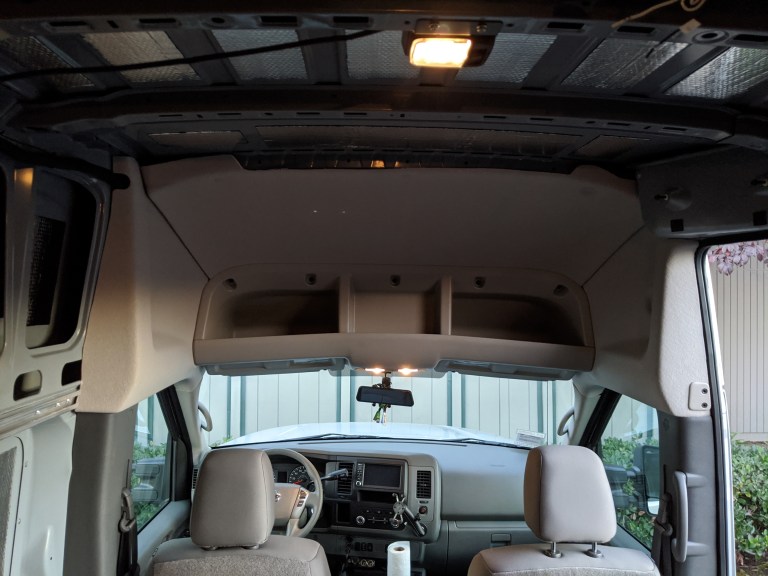
I have been struggling with trying to come up with a good way to put together the ceiling.

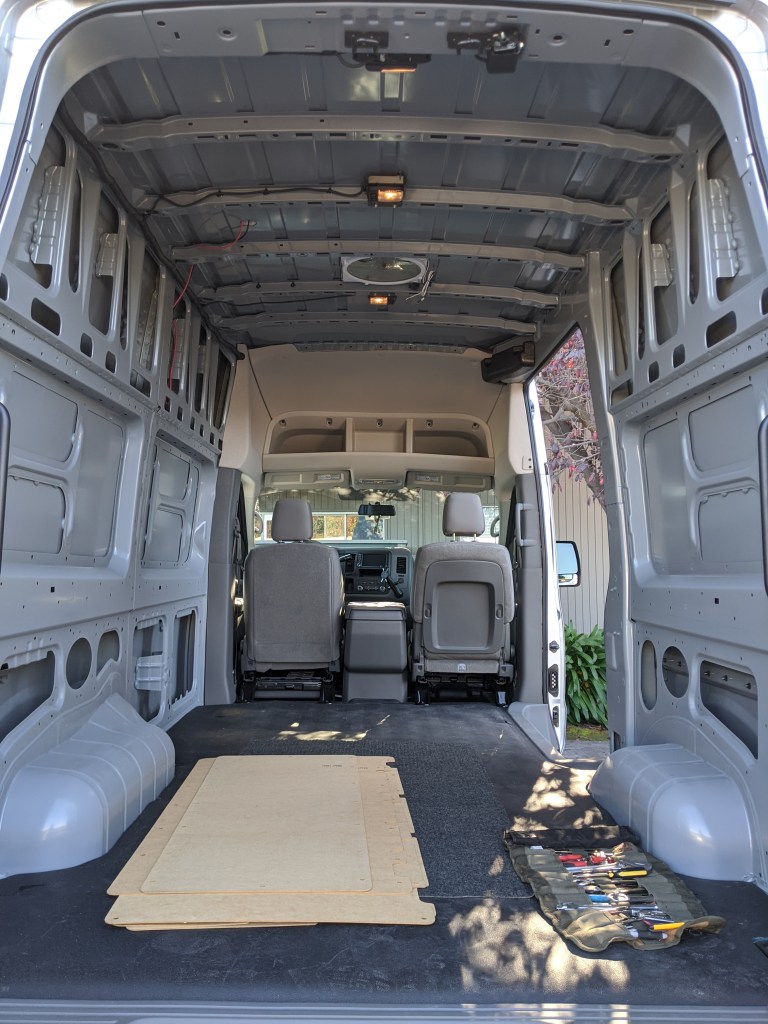
Since I decided to go with cedar tongue and groove panels for the ceiling, that basically requires wood furring strips to screw the hundred or so screws that are going to hold up those panels.

However, I’m also planning on mounting some overhead cabinets/shelving made from 80/20 extrusions, and so needed to figure out a structural method to secure those to the ceiling.

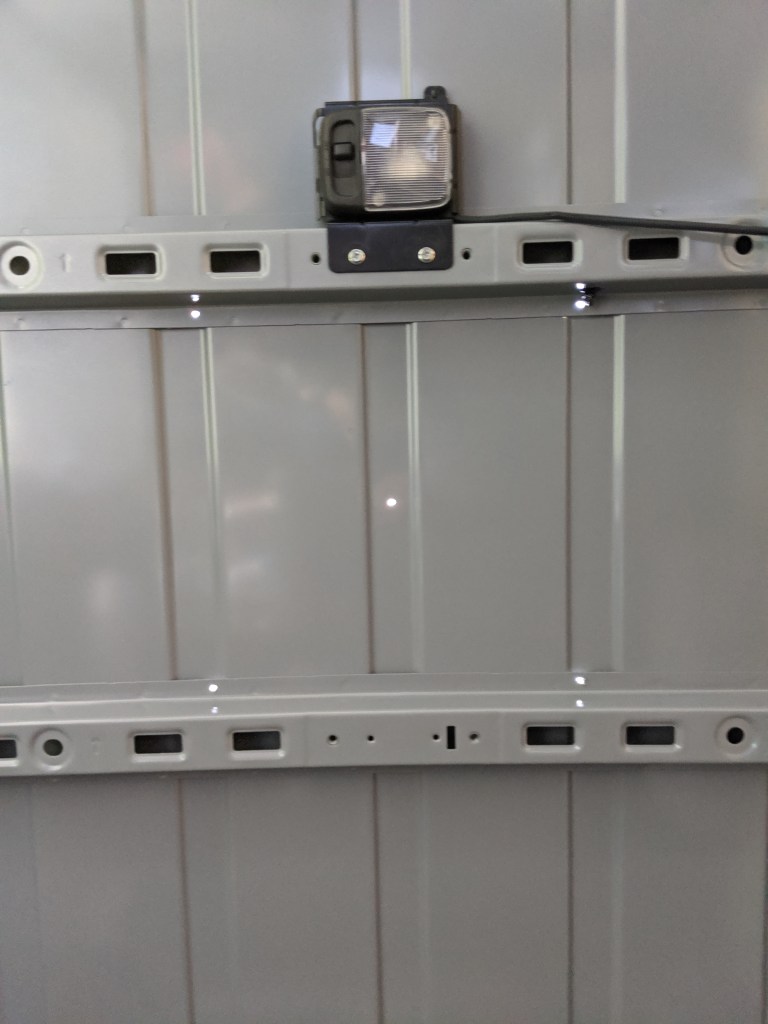
The way the sheet metal roof ribs are in the van, there’s two threaded M8 mounts in the middle of each of the ribs, and a whole bunch of holes throughout the rest of the ribs.
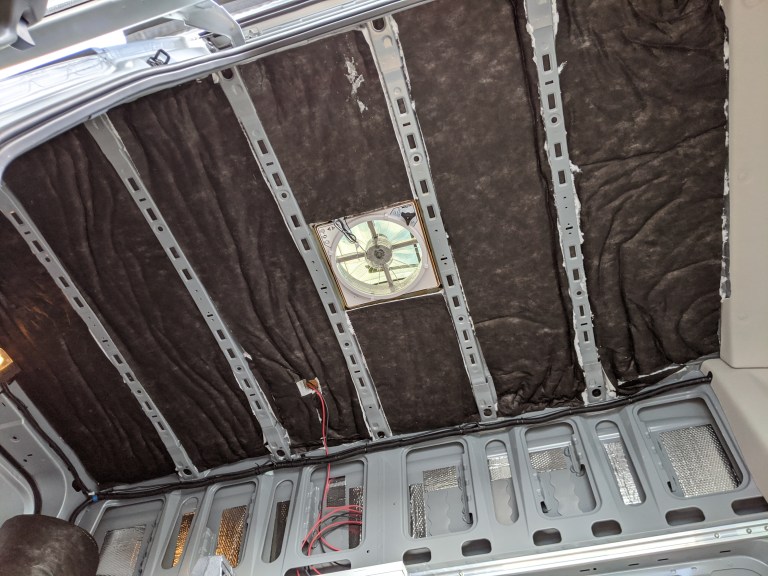
IMG_20191129_115929

First, I tried using some furring strips and bolting them straight to the mounts, using the bolts to bend the strips in the middle to fit the curve of the ribs. This was before I came up with a way to mount the overhead shelving, but immediately realized this wouldn’t work.

With all of the flex that happens naturally in the body and chassis of the van just from driving, the wood strips creaked with every tiny little movement. Drove me crazy pretty much immediately, so I scratched that idea.

In the end, I ended up using the same 1×2 boards, but modified them pretty extensively.

I drilled some 3/8″ holes into the roof ribs close to the walls, and installed some 1/4″x20 plus nuts. This way, the wood 1x2s can be structural, since the cabinets will have support from the wood boards being bolted to the roof ribs on both sides of where it mounts.

The M8 middle mounts were spaced down by 1/2″ to reduce the amount of curvature and pressure on the wood. The 1/4″ edge mounts were spaced down by the same, but this was done so there isn’t so much direct pressure from the wood on the metal ribs, to eliminate the creaking. There still was some contact between the end of the wood strips and the metal, so I placed some closed cell foam weatherstripping to eliminate direct wood-to-metal contact.

Then I hung some 1/4″x20 carriage bolts down from the 1x2s where I’m planning on mounting the cabinets. This is a much more secure method of bolting the cabinets, compared to screwing directly into the wood.

The whole thing was painted to try and make the wood more resistant to moisture. Try to ignore the tearout around the holes, I’m not a carpenter :).

This entire assembly then gets bolted up to the sheet metal ribs using the 4 bolts.
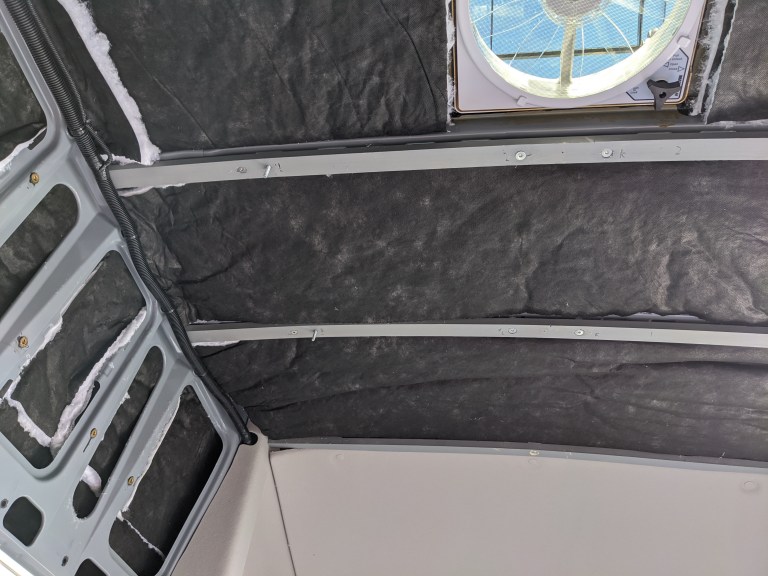
IMG_20191208_111001

Now I can screw the cedar planks into the furring strips, and still have a positive mount to bolt the cabinets into.

I also needed to fabricate some strips for the front and rear of the roof, where the original headliner and third brake light are, respectively, since there are no roof ribs there to support the cedar planks. That ended up being 2 stacks of cutoff bits of 1×2 at the ends up the strips to bend them down to match the curvature of the rest of the roof, and the middle was bolted to existing M8 and M6 bolt holes on the roof sections of the B and D pillars using 90* aluminum angle brackets.

In the end, I do lose roughly 1.5″ of ceiling height with all of these shenanigans, but I’m not a tall person, so there’s still plenty of space.

This took a lot longer to figure out than I originally planned. Who would have thought putting up a ceiling would be so difficult?

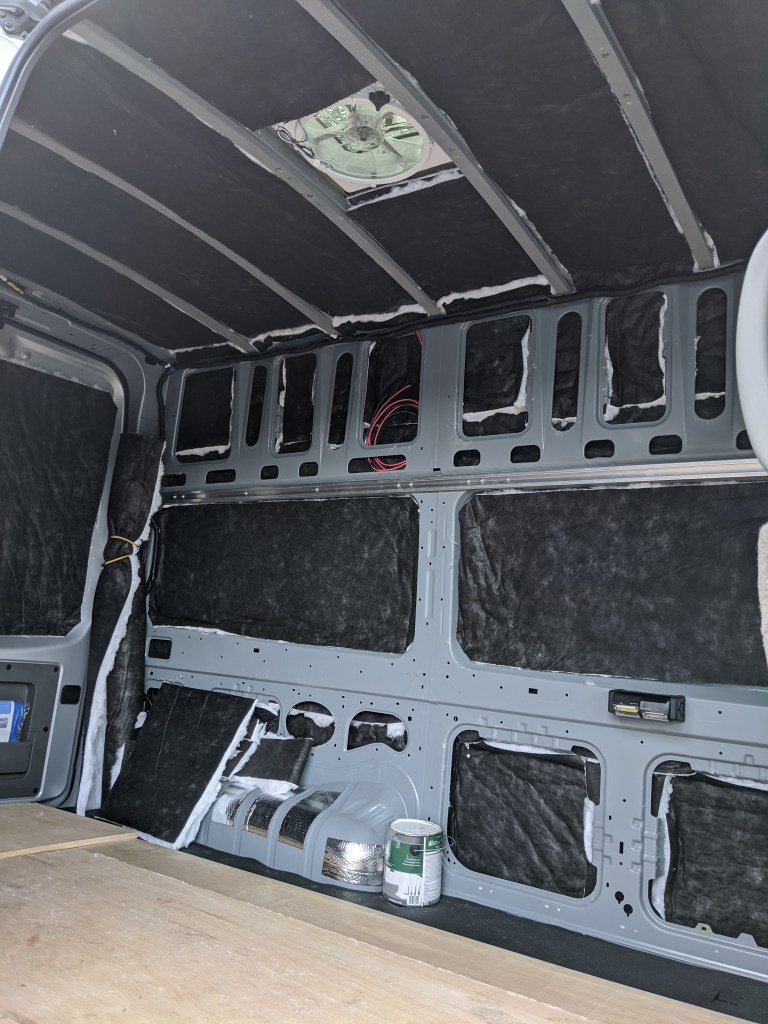
Insulation.

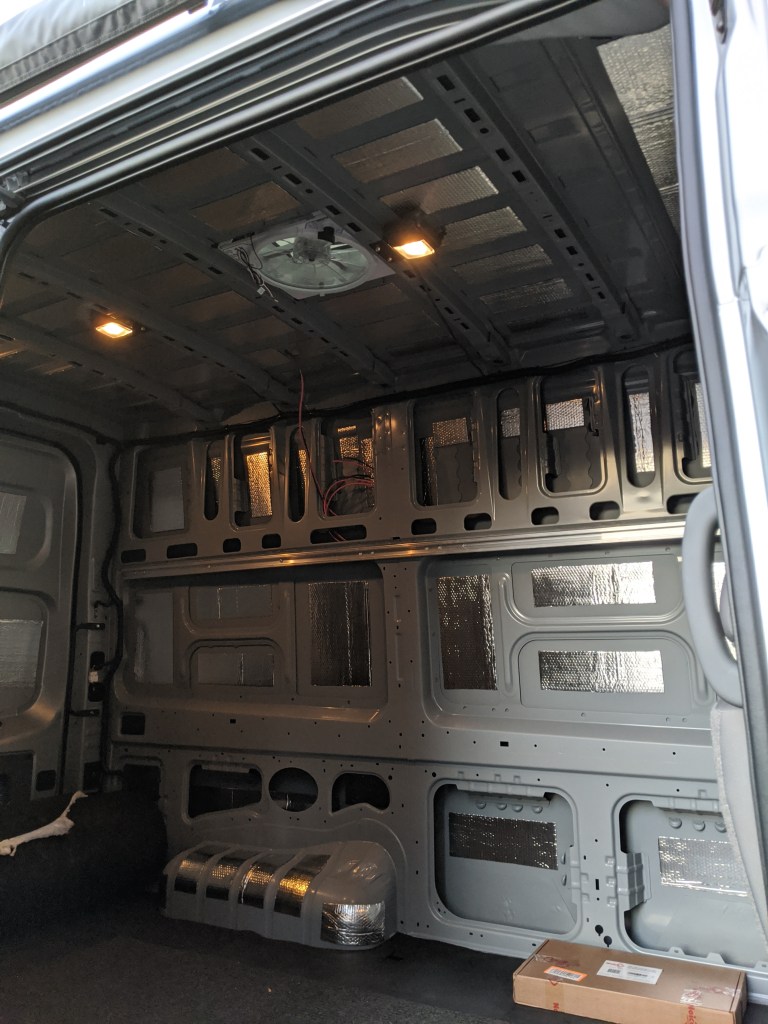
There isn’t too much to say for insulation, I finally finished installing it throughout the van.

I used a 50 ft roll of 3M Thinsulate, and had maybe 5 feet left over after all was installed in the van. 3M Super 90 was used to glue the insulation in place where it wouldn’t hold on it’s own.

The reasons for choosing this particular form of insulation are already well documented on the internet so I won’t go into too much detail, but it’s hydrophobic and resistant to mold/mildew, it’s easy to cut and fit into place, has some sound-deadening properties, and doesn’t squeak like foam boards can. Overall just a very easy worry-free method of adding some insulation to a vehicle.

No Reflectix or vapor barrier, I think those are both pretty counterproductive in a van, because it’s difficult to maintain an air gap for the Reflectix given space constraints, and the vapor barrier is likely just to trap moisture somewhere and cause rust. Cars need to breathe and be able to dry out.

The main thing I tried to do when I installed it all is overlap the panels of Thinsulate where they meet, to avoid as many exposed sheet metal areas as possible. It’s questionable how effective this will be, given that the inner structure of the van provides a lot of thermal bridging all around the insulation, but we’ll just have to see. The doors are also insulated, but the same thermal bridging takes effect pretty badly for those too.

The insulation is doubled up on the roof, because I had the space to do so, and because that’s where it’s likely to make the biggest impact.

I used fish tape to thread insulation inside of the roof ribs, but I chose not to insulate the B, C, and D pillars of the van for a few reasons. It’s probably not worth the modest return on insulating effectiveness because of the massive thermal bridge that the pillars provide anyway, I would like to be able to access the tail lights and wiring in case I ever need to replace them, and it’s really difficult to actually stuff the insulation into the pillars, accessibility is terrible.

IMG_20191125_210641

The insulation was frankly the easy part, recently I’ve been struggling with how to mount the ceiling and overhead cabinets. The roof ribs have a ton of holes which make it difficult to mount to, so I ended up coming up with a probably overly complex, somewhat structural, furring strip system. Details to come.

IMG_20191129_115929IMG_20191205_120412

Removing the headliner and installing sound deadening.

This weekend I installed Noico sound deadening panels throughout the van, and the beginnings of insulation in the headliner area.

Removing the headliner on the NV is really pretty simple, Nissan broke it down into multiple panels, which makes maneuvering everything much easier.

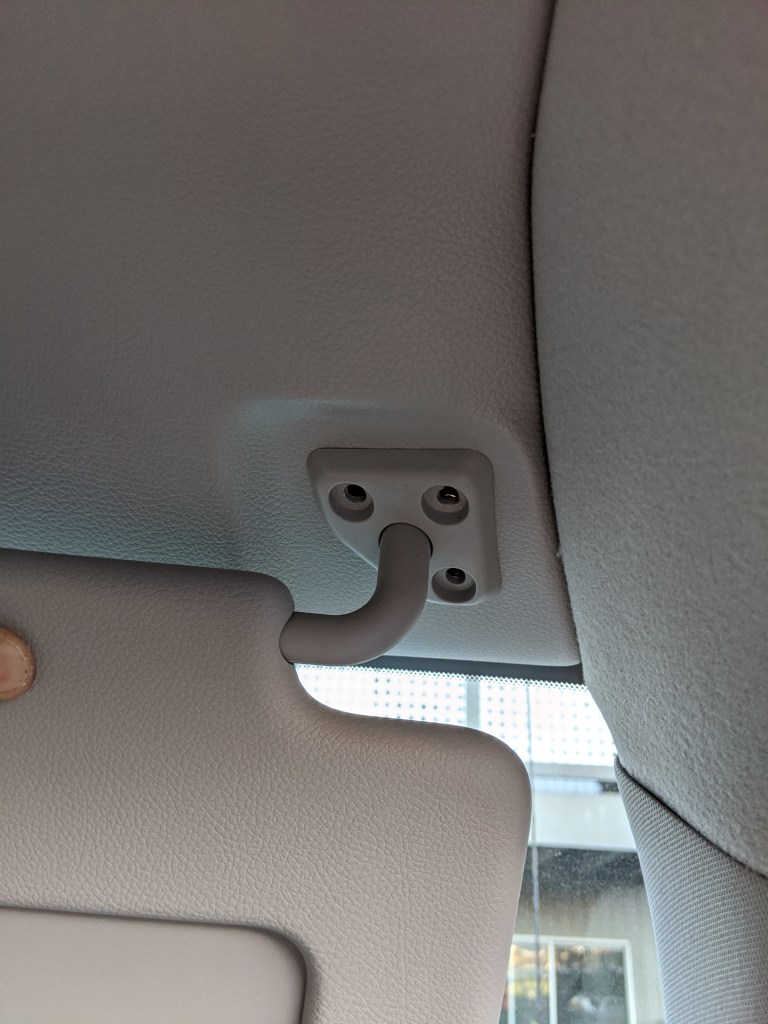
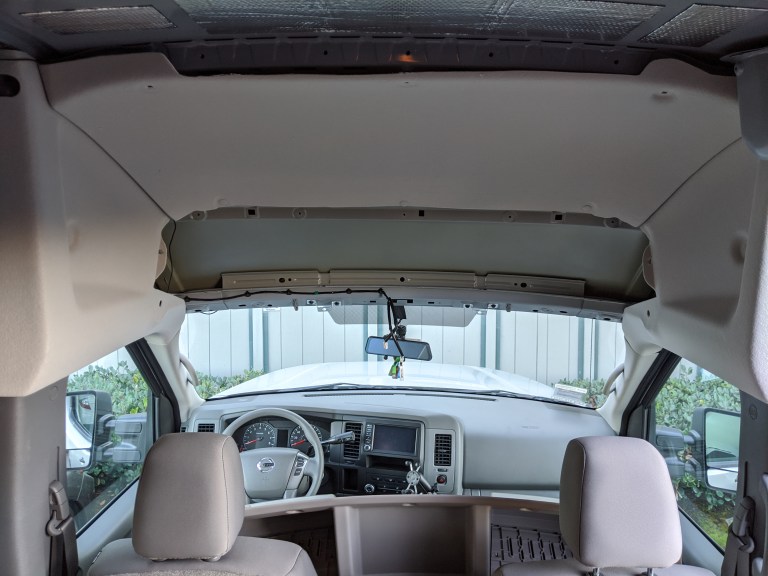
You start by removing the overhead shelf, which necessitates removing the sun visors too. There’s 5 bolts up top in the back, and another two under the visors. The visor clips are removed by turning them 90* and pulling them out, and the sun visors are removed with 3 Torx head screws each.

IMG_20191117_152225IMG_20191117_152935IMG_20191117_152659

After that, you just pull the shelf straight back, and it pops out. There’s two wire harnesses attached to the overhead map lights that you need to disconnect, and then it just drops free.

IMG_20191117_153522

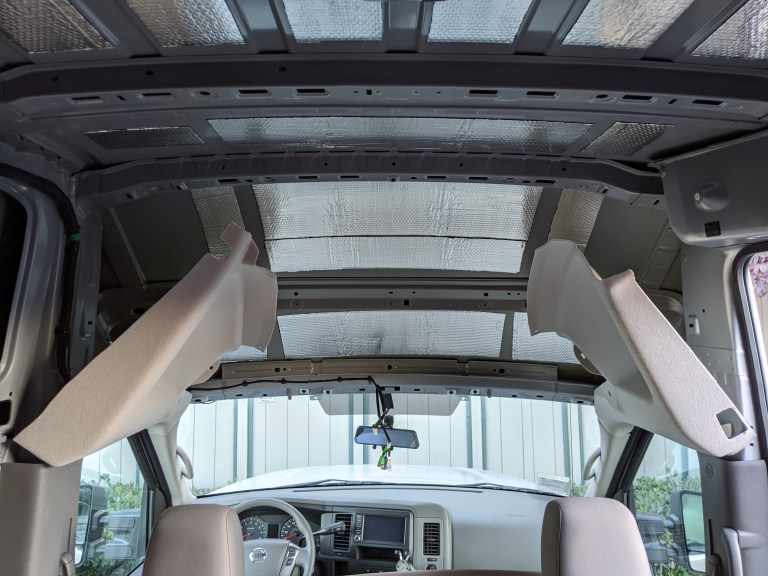
The overhead panel for the headliner is removed next, and that’s just held in with 6 push clips, 3 in the front and 3 in the back, that you can remove with a trim removal tool.

IMG_20191117_153609

The side panels are held in with a few more of the push clips, and then they can just be folded down out of the way. The one on the passenger side has a panel held in with 2 Allen bolts that needs to be removed too.

IMG_20191117_153740IMG_20191117_153836IMG_20191117_153732

There’s not much to say for the Noico installation, I cut the panels to fit, then used a roller to press them on to the sheetmetal. Complete coverage isn’t required, so I just covered each panel with a roughly sized piece. Nissan included some dampening panels in some areas already, so I left those alone. It didn’t take terribly long to do the whole van, although it did require some effort to roll and press each panel on.

IMG_20191117_155754

Since I probably won’t be touching the area behind the headliner again,, I insulated behind it using some 3M Thinsulate , and re-installed it in the reverse order.

IMG_20191117_162201IMG_20191117_165734

All the panels sound much more solid now, and hopefully the insulation and sound dampening behind the headliner will quite down the road/wind noise a bit. That front panel sounded quite tinny before.

Finished result:

IMG_20191117_165756

Now I need to finish installing the insulation throughout the rest of the van.

Recovery points and roof rack installed.

Did some smaller easy modifications today. Pulled all of the hardboard off of the interior walls in preparation for installing insulation/sound deadening, and installed the roof rack along with some recovery points.

IMG_20191115_123700

I was mindlessly browsing the internet for a way to add some recovery points back into the front of the vehicle after removing the tow hooks to install the push bar, when I ran across these tow points for a 200 series Toyota Landcruiser from Australia:

https://www.ebay.com/itm/Heavy-Duty-Recovery-Tow-Point-Pair-suits-Toyota-Landcruiser-200-Series/401932868419

IMG_20191114_173055

Curiosity got the better of me, as doing some quick eyeball calculations based on relative sizes in the pictures, the mounting bolt holes looked suspiciously close to the 6″ center-to-center distance that the Nissan’s tow hooks have. So I bought them, not knowing 100% if they would fit.

Turns out they fit perfectly. The distances for the mounting holes are exactly the same.

So here they are, mounted on the van:

IMG_20191115_100415

They have a 5000kg. working load limit each, so they’re plenty strong. I bolted them up under the mounts for the bull bar, and there’s plenty of clearance to attach a shackle to them. Mounting them inside the push bar allows for the use of a bridle, should the need arise.

Sometimes you just get lucky.

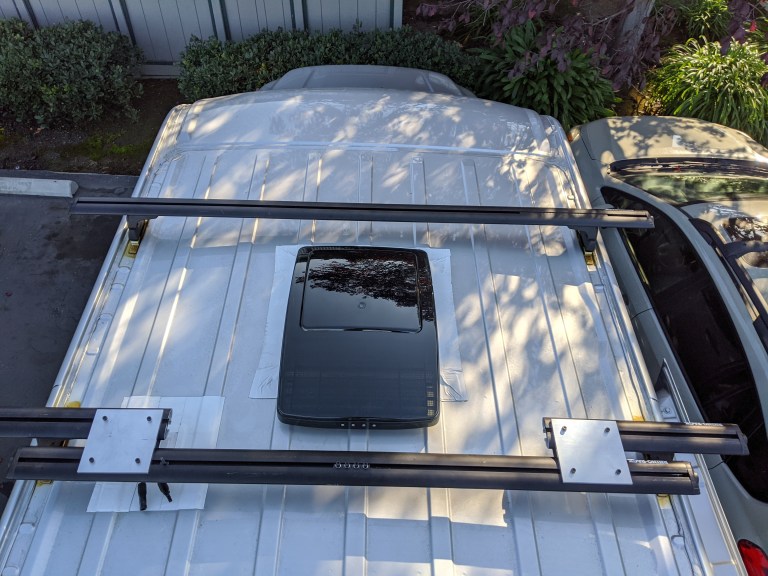
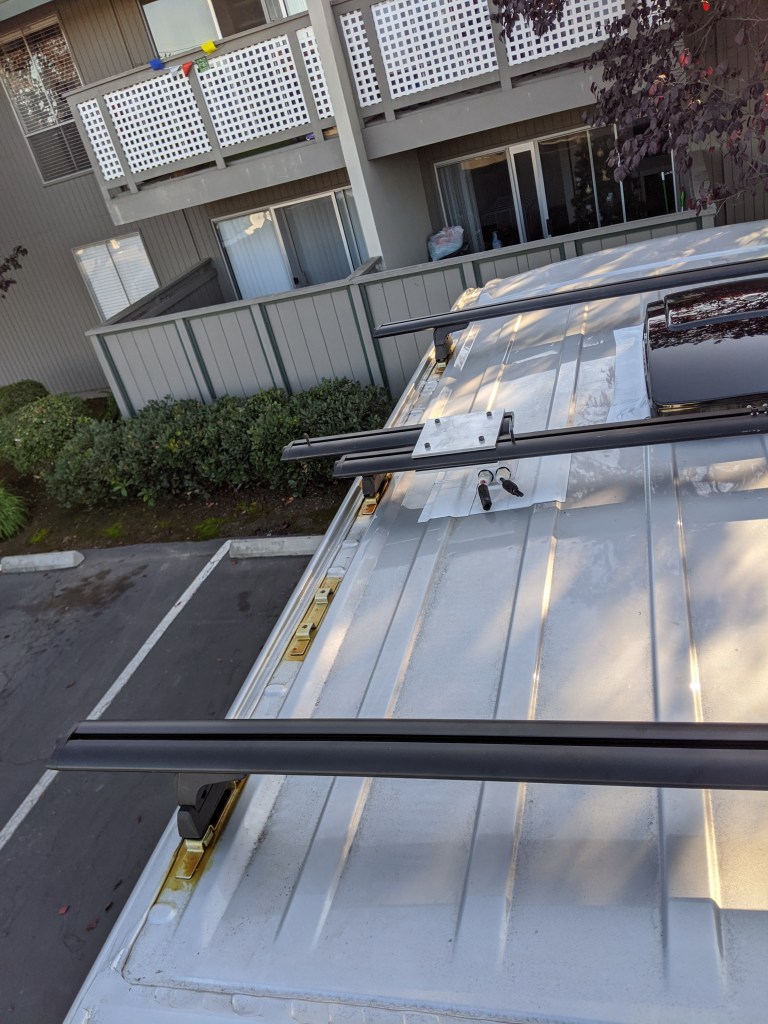
Next I installed the roof rack. I chose the Rhino Rack Vortex RLT600 system, as this came off of my trailer and I had most of the parts on hand, saving some money.

Looking at the roof rack mounting points, I wasn’t happy with the finish on them and how they were welded to the roof, so I sprayed them with a coat of Amsoil Heavy-Duty Metal Protector to ward off rust, then I bolted the roof rack on. I used this stuff to coat the frame of my Tacoma, and it works amazingly. There wasn’t a spot of rust after 3 years in the Midwest salty winters.

IMG_20191115_130326IMG_20191115_130559

I used two 70″ bars, and modified two 60″ bars to make a third 70″ bar with an offset in order to clear the MaxxFan. I already had the shorter bars on hand, so they would’ve been useless otherwise anyway. The way the rack mounts are on the Nissan, the bar would’ve fit without modification for a Fantastic fan, but the MaxxFan is much larger. The next set of rack mounts are too far back and too close to the rear bar for my needs.

IMG_20191115_135117IMG_20191115_135143IMG_20191115_135226


First modifications: cutting holes in the van.

The plan is to install a roof vent, roof port for wiring, and the side window in the sliding door. I did this the second day I had the van. There’s nothing quite like cutting a hole into a brand new vehicle. 🙂

I had bought all of the following parts beforehand while preparing for the van build.

Some notes about the product choices: the roof vent adapter is nice because it fits between all of the raised ribs on the roof, making a flat surface for the vent flange to mount to. I also chose Eternabond instead of the more commonly used Dicor sealant or any other silicone-based sealants. I’ve used this in the trailer install as well, and I trust it completely to last as long as claimed (10 years). It’s easier and quicker to apply, and it’s some of the most flexible/stretchy/sticky stuff I’ve ever seen. There’s no way for it to crack, and as long as the adhesive sticks (which there’s no way it won’t), you have complete sealing around the entire tape edge.

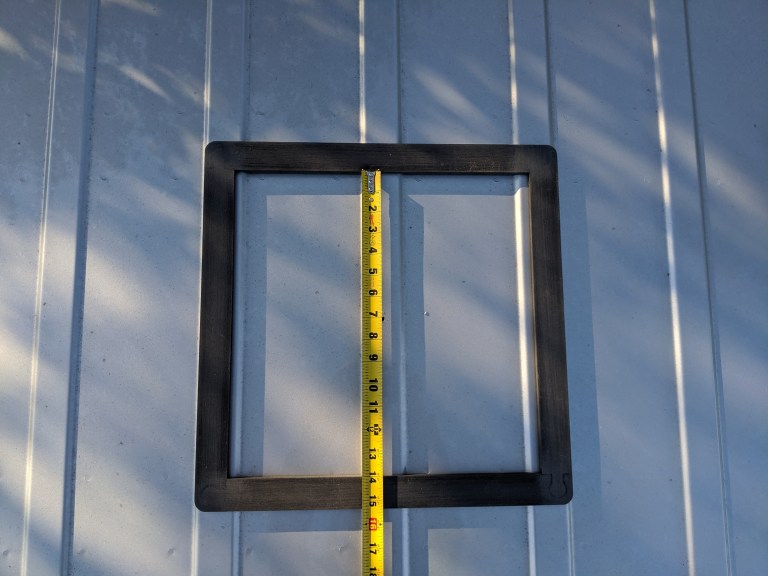
To start, I measured the roof spacing inside the van between the ribs. This ended up being 14.5″ where I wanted to install the vent fan, just barely enough room. I marked the center between the ribs, and drilled a locating hole in the roof.

IMG_20191030_091529

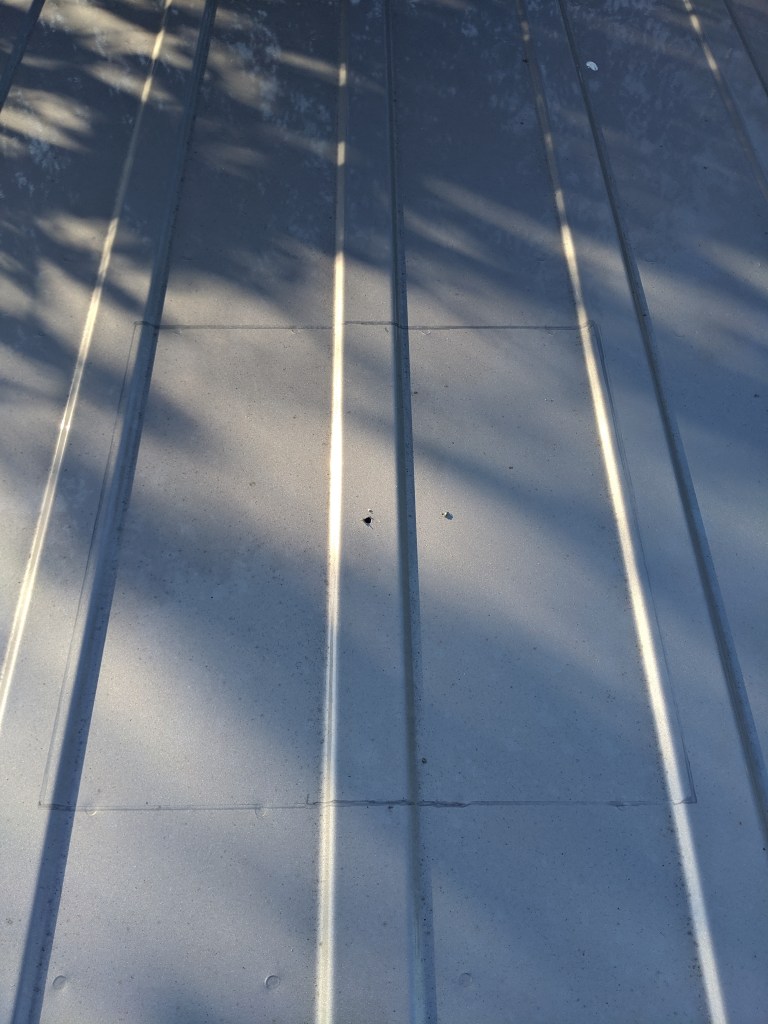
I crawled onto the roof of the van with the spacer, and using the locating hole to center the spacer, marked around the inside perimeter on the roof of the van.

IMG_20191030_092036IMG_20191030_092231

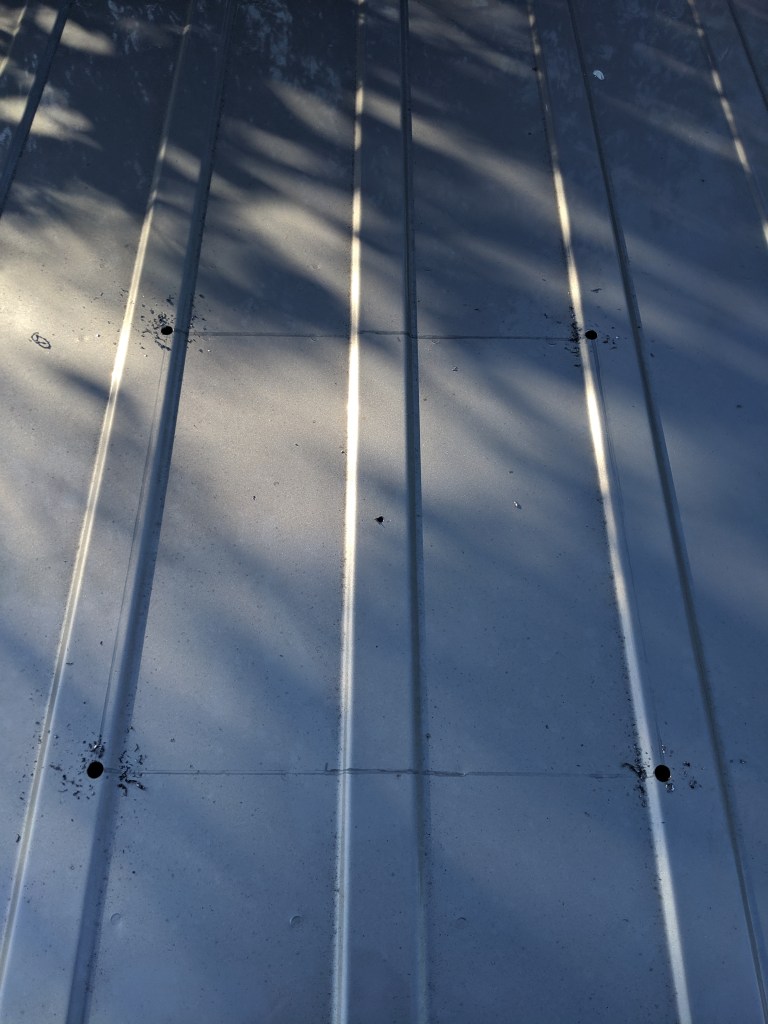
Next, I drilled 3/8″ pilot holes in the corners of the marked outline, and double checked the fit from inside the van.

IMG_20191030_093120IMG_20191030_092722

Everything looked good, so I taped up the outline to protect the paint. Then there was nothing left but to cut out the hole. I just used a cordless jigsaw with a metal cutting blade for this, and then used an angle grinder with a flap disc to clean up the edges.

IMG_20191030_094554

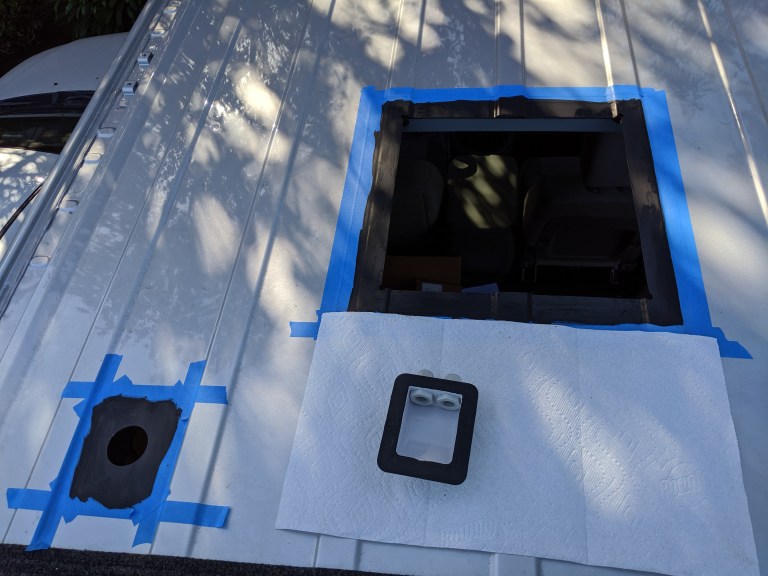
Once the hole was cut, I relaid the tape outline around the outside perimeter of the roof vent adapter, scuffed up the paint inside the tape, and primed the cut edges with the 3M Window Weld primer, along with the outlined area. This is to prevent rust, as well as give the Window Weld urethane adhesive a good surface to adhere to. I also primed the roof vent adapter, but I’m not sure this was actually necessary.

At the same time, I used a 2″ hole saw to drill another hole in a flat section of roof away from the ribs (close to the second roof rack mounting bracket), and masked off/primed that area along with the port gland to be glued as well.

IMG_20191030_104922IMG_20191030_105923

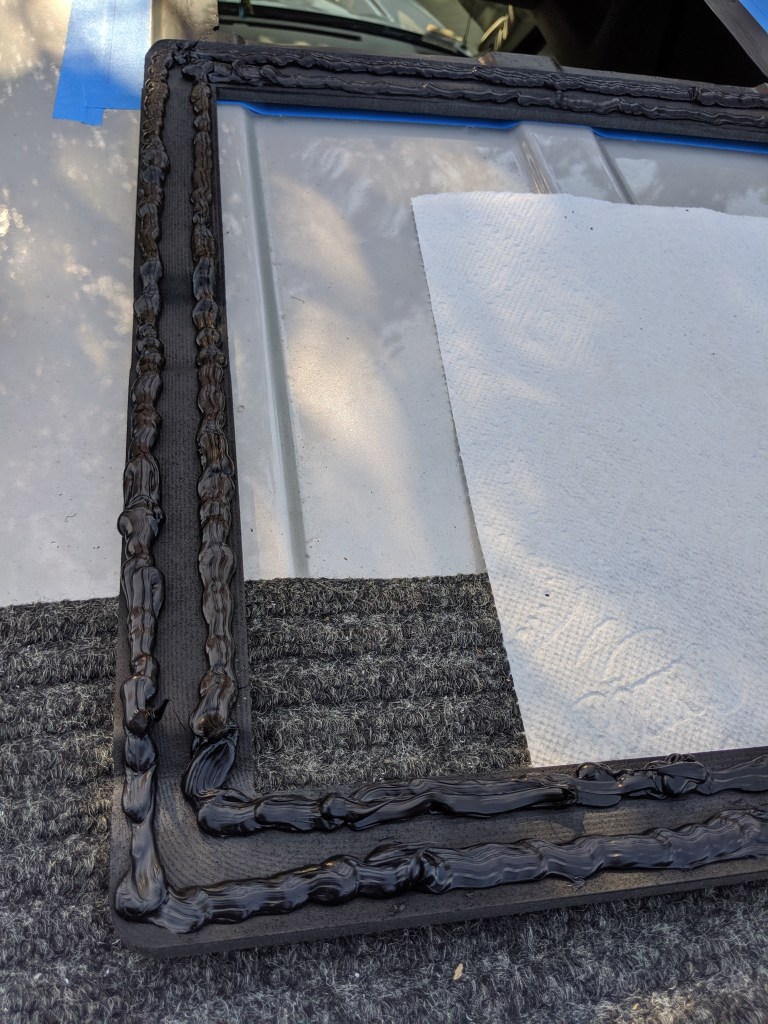
Two beads of the 3M adhesive were laid around the roof vent adapter, and one bead around the port gland. Then I simply lined them up, and pressed them down evenly onto the roof of the van.

IMG_20191030_115151IMG_20191030_120350

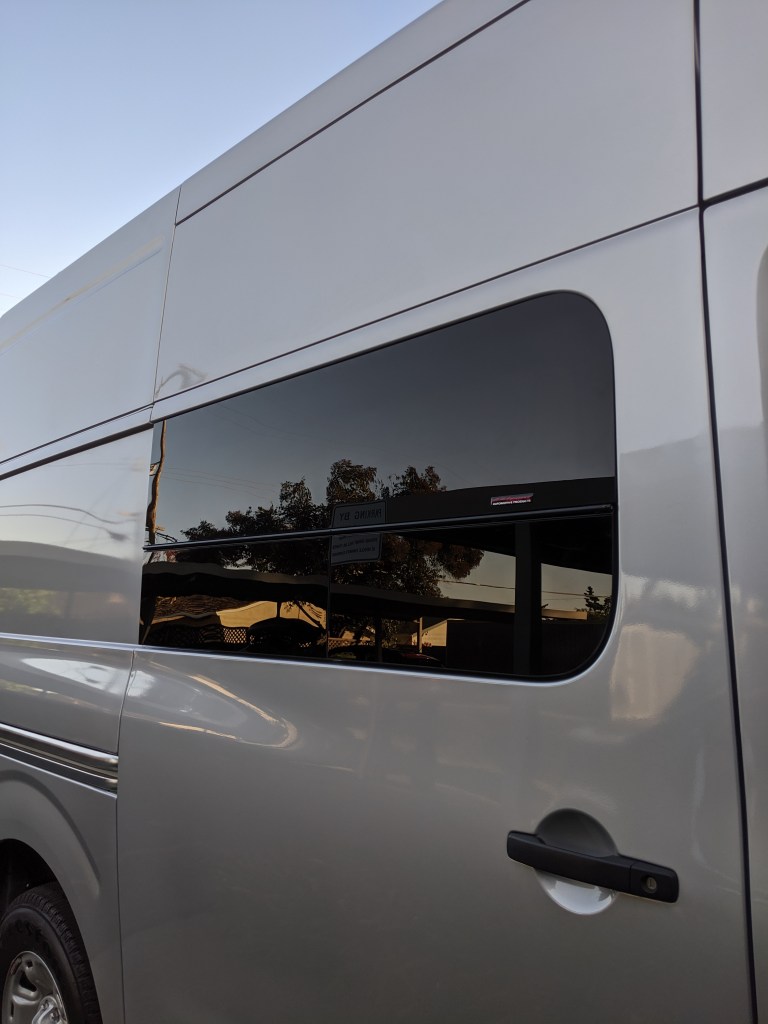
While the glued down bits on the roof were curing, I cut the hole in the door for the window.

I didn’t take as many pictures of this part, as I was much more nervous doing this than when cutting the holes in the roof, and spent all my efforts concentrating and forgetting to take pictures. The roof was all straight vertical cuts, this door window has compound curves in a horizontal plane.

I did a significant amount of research beforehand on the best way to go about doing this, specifically focusing on OurKaravan and Seven O’Savage‘s processes, but in the end, I did it completely differently than they did.

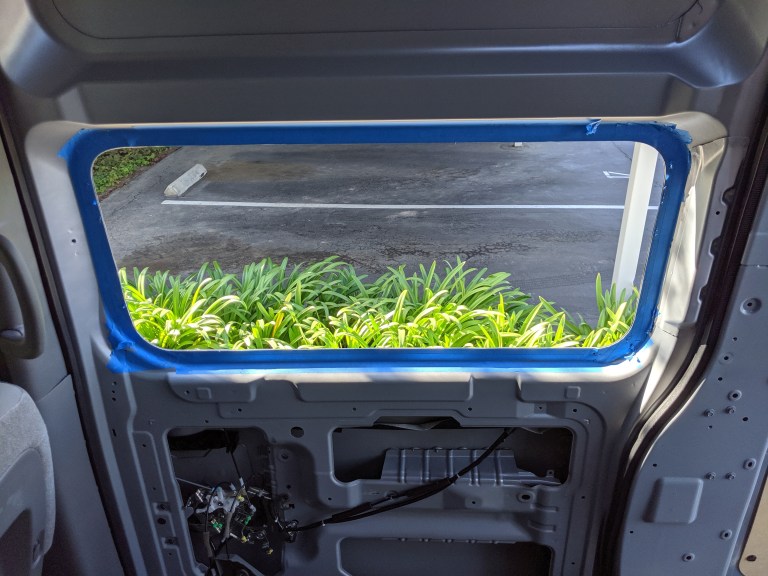
Their processes involved transferring the outline of the cut line to the exterior of the van, and cutting from the outside. But when I took a look at my van, it turned out that there was just enough room to fit the jigsaw in the door frame to cut the outline from the inside, which is much faster and simpler, albeit slightly more nerve-wracking with how little room there is to maneuver.

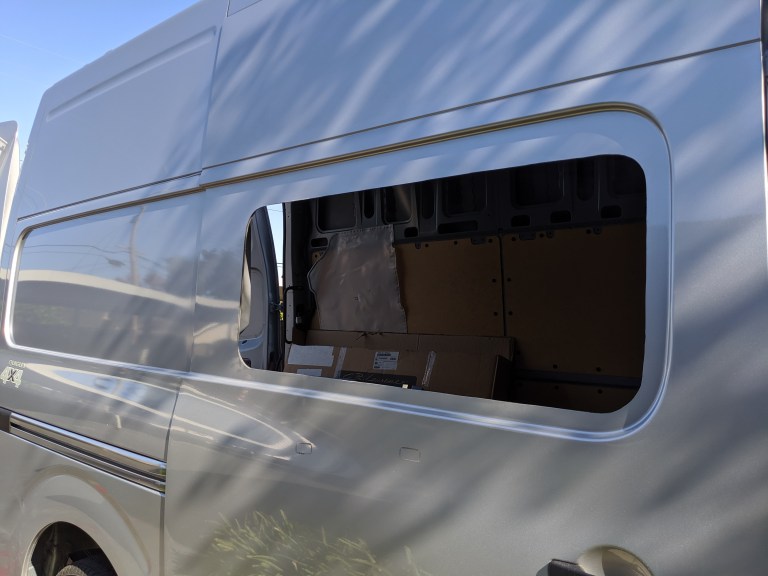
So all I ended up doing was masking around the door frame following the doubled up sheet metal outline, drilling a pilot hole in the bottom of the outline, and cutting around the inside of the outline. I started from the bottom, and went around each side, doing the top last. The corners were definitely the hardest part. Once the sheet metal was cut all around, I used the angle grinder with the flap disc again to clean up the edges and fine tune the corners.

IMG_20191030_133134IMG_20191030_133121

Again, I primed the cut edge, and then just dropped the window in, and screwed in the mounting flange.

IMG_20191030_161125

Finally, once the roof vent adapter and cable gland were cured, I applied butyl tape around the roof vent mounting flange, dropped it down on to the adapter, drilled the mounting holes, screwed it down, and sealed around both the vent flange and the cable gland with the Eternabond tape, overlapping the tape to make a complete seal. The tape is reallyy sticky and stretchy, so it was hard to get it perfect without wrinkles, but the edges are all completely sealed, which is the important part. Then I dropped the MaxxFan in, and screwed it to the mounting flange.

Done!

IMG_20191030_182752

Final result:

IMG_20191031_170814_1

Too bad you can’t actually see the vent on the roof.

Addendum: I also installed a Prime Designs rear ladder (to access the roof), and a push bar on the front, but those were so simple to install that they’re not really worth going into detail on. The ladder you just hook on the top of the rear door, and tighten down the hooks on the bottom. The push bar just bolts on, and I installed it because the bumper on the van is mounted flush and doesn’t really protect any of the painted bits in case you bump something (like the pole in front of the van), so this adds just a tiny bit of padding. It rests against the actual metal bumper with a little rubber pad, so although it might potentially be a damage multiplier in an actual accident, it should protect the van from day-to-day parking incidents. It’s a big vehicle with a long nose.

I bought a van.

IMG_20191029_175336

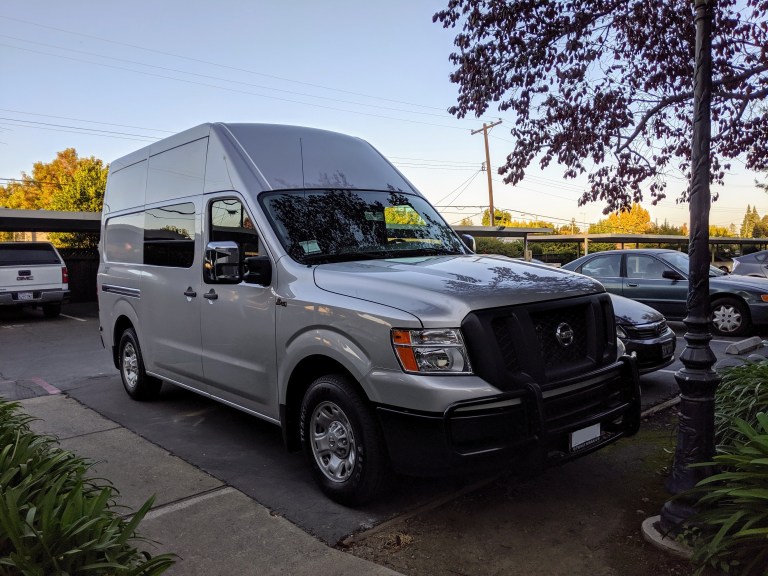
I bought a van. Well, technically 6 months ago I did, and I finally took delivery of it.

Ordered a 2019 Nissan NV 2500 SV V8 High Roof, and had it delivered from the factory to Quigley for the 4×4 conversion. Then it was shipped all the way to California for pickup.

Having come from the Tacoma and Cricket combo, I had a pretty good idea of what worked, and what didn’t work, and what was important to me.

This specific build is the closest to checking all my boxes.

More specifically, the main reasons for choosing this particular vehicle:

  • Standing height interior.
  • Body-on-frame construction.
  • 4 wheel drive (via Quigley conversion)
  • Ease of maintenance.
  • Horsepower and towing capacity.

The Nissan is the only body-on-frame van that’s available with a high roof option. The truck-style front end offers accessibility to the engine bay that’s not available with more traditional vans, like Sprinters or Transits.

Sprinters and Transits are unibody construction, and have much smaller/weaker engines and a much lower towing capacity. Their 4WD/AWD systems are also not true part-time 4WD: The Sprinter has a planetary gear reduction reducing power to the front wheels, and the Transit is a computer-controlled system and wasn’t available with AWD until 2020.

The engines on both of those models are also smaller, and turbocharged, adding complexity with regards to maintenance. Too complicated, in my mind, for true long-term durability in the adverse/abusive conditions that I tend to put my vehicles in.

Yes, you do end up sacrificing some interior volume, but everything’s a compromise. I choose to prioritize the more traditional ladder-frame construction, V8, and 4×4 system over comfort and living space.

Now it’s time to start the build.

Sink/Electrical cabinet build.

My future van does not have the most interior space, so I wanted to keep everything as efficiently laid out as possible. In the design I have in my head, this involves sticking as much of the water, electrical, heating, etc. into one unit.

Key design criteria:

  • Accessible. All electrical and plumbing must be easily accessible for troubleshooting, modification, or repairs.
  • Short wire runs. I want to minimize the amount of long wire runs to the minimum necessary:
    • Alternator to charge controller.
    • Solar to charge controller.
    • Roof vent/interior lights to fuse box.
    • House batteries to fuse box (short as possible).
  • Modular. The entire assembly should be relatively easy to remove, should the need arise.
  • Simple. I prefer to save time and effort using already-existing products and furnishings where possible. Also, I prefer working with metal to wood.

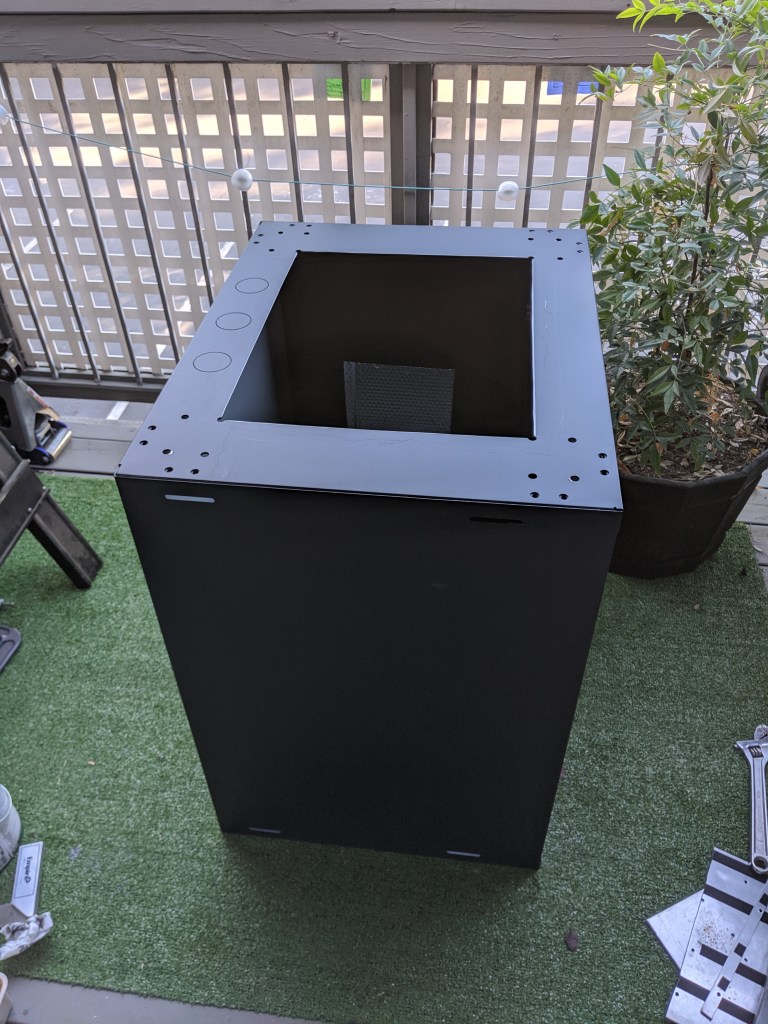
I ran across this product at Home Depot: New Age Products Pro Series 3.0 Garage Cabinet Sink. The dimensions happen to be perfect for what I want to accomplish, and it saves the time and effort of building an entire cabinet. It’s also made of sheet steel, so it should be much stronger than a wooden-framed or pre-fab particle board cabinet.

Furthermore, Home Depot’s 26″ hardwood workbench top fits rather nicely both in, and on top of this sink assembly.

This allows me to easily turn the sink into counter space, and also allows me to cut an access hole in the bottom of the cabinet for access to a Propex HS2000 heater I’ll be installing underneath. Since this benchtop is already cut to size and finished, it ends up saving a lot of time compared to cutting down a sheet of plywood, sanding, painting, etc. It also might actually be slighter cheaper overall.

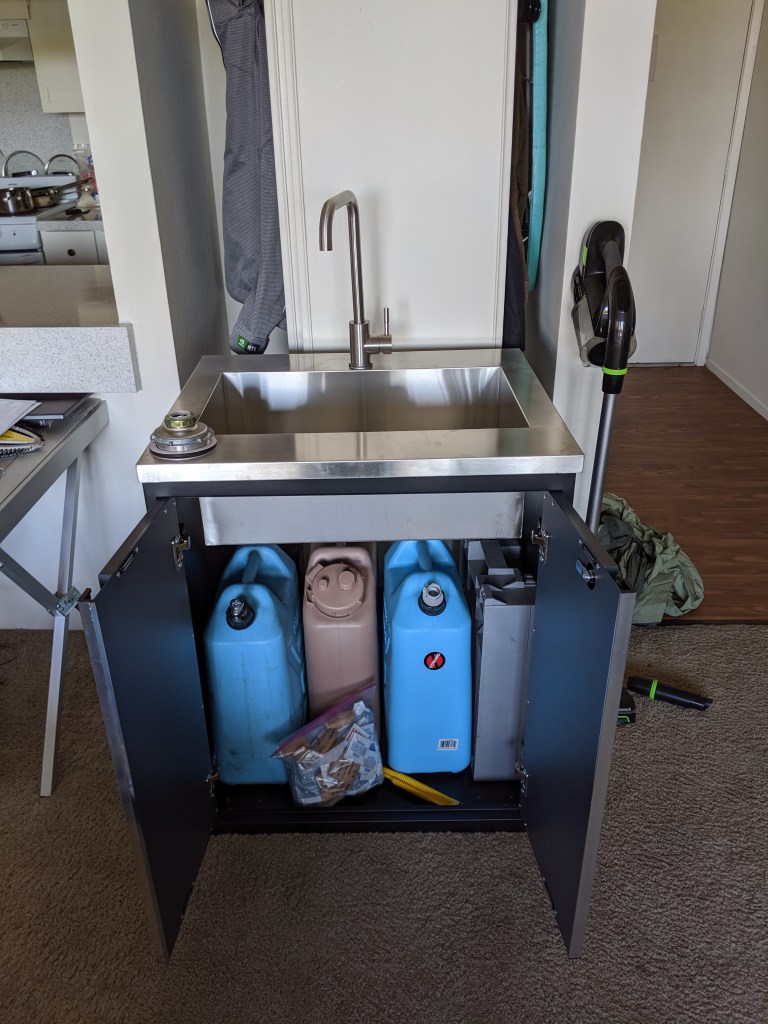
So I mocked up the interior of the sink:

IMG_20191012_120150

It fits 2 5 gallon Scepter water cans, a 5 gallon LCI USGI surplus water can, and a portable toilet perfectly, with plenty of room left over for the electricals.

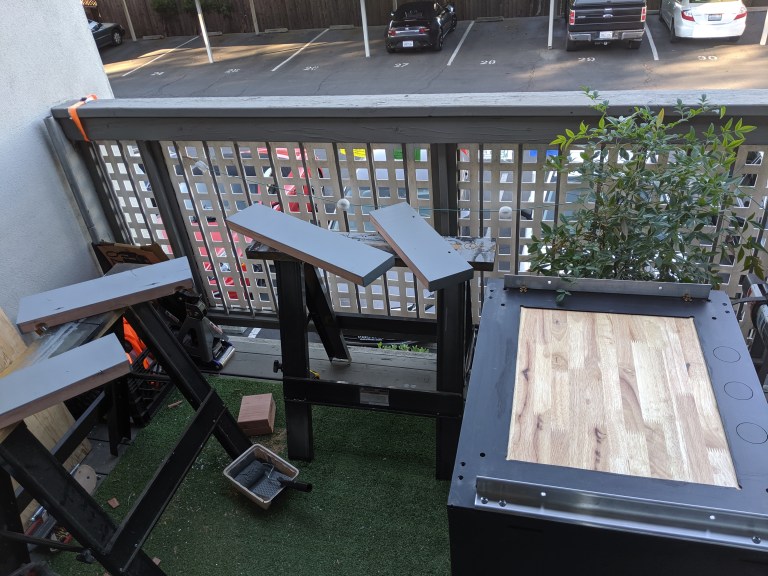
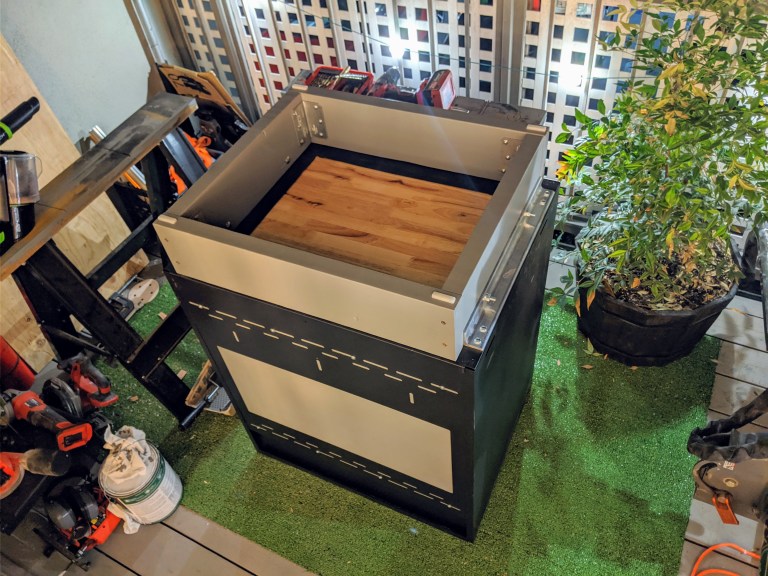
To modify the sink assembly, I first cut a hole in the bottom of the cabinet, and used 2×6 boards to create a riser for the cabinet. This creates a space under the cabinet to mount the Propex heater. It raises the sink height to 39″, which is a little high, but just about the height of a standing desk. I covered the access hatch from the inside with the hardwood cabinet top from Home Depot, sealed around the opening with foam weatherstripping, and bolted it down using 1/4×20 plus-nuts. This way, the heater is easily accessible by removing 4 bolts, without needing to remove the entire sink assembly, and the floor of the cabinet is still watertight (after I cover over all the other holes).

IMG_20191018_160355IMG_20191020_163836IMG_20191020_213204

Next, I bent a stainless steel kick plate for a door to create a backdrop for the sink, so no water runs behind the cabinet. This was installed with a combination of rivets and 3M VHB tape, and sealed with silicone.

The whole assembly:

IMG_20191021_093155

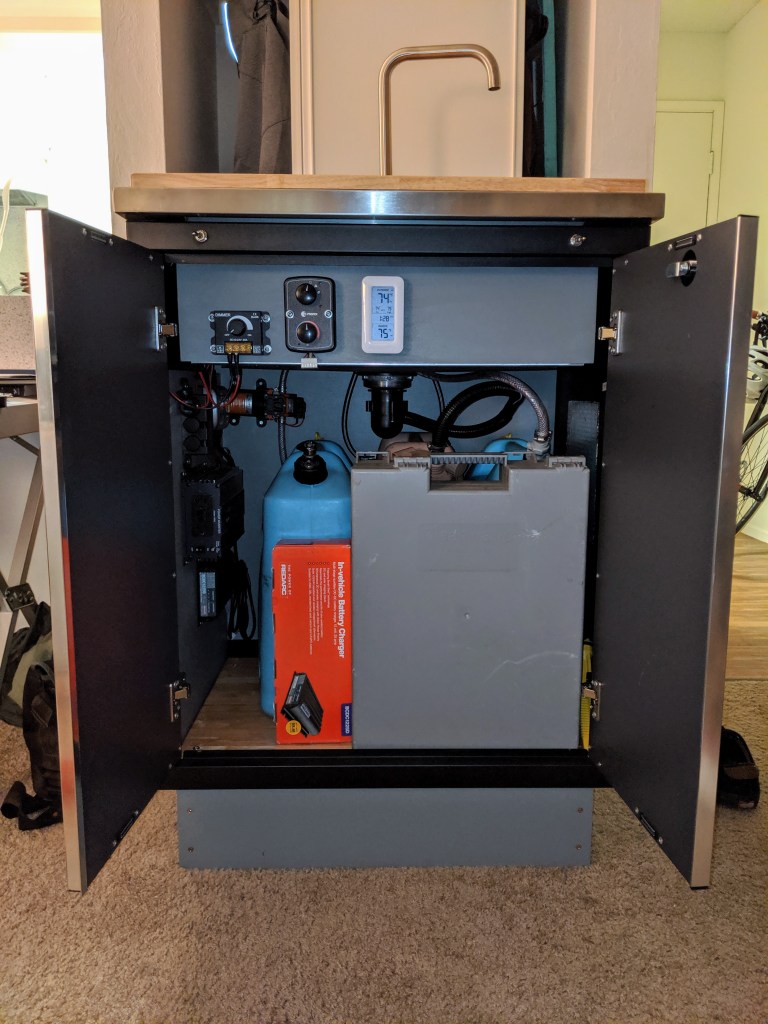
The plumbing comprises of the faucet and drain that came with the sink, a Seaflo 1.2 GPM diaphragm pump, a tee fitting to convert both compression fittings from the faucet inlets to a single 3/8 barbed fitting, and a Camco camper drain. The LCI can serves as the gray water tank, and the blue cans are potable water, using these quick-connects to connect the suction line to the water pump. The Camco drain plugs right into the LCI can using a double-ended barbed adapter, and is easily removed to empty the can.

For electrical, I cut a 3/4 plywood 2′ x 4′ hobby board down to size to use as the panel to mount all the electrical components to. I’m using a REDARC BCDC12225D dual battery charger. It has inputs for both solar and alternator power, and handles the switching and charging automatically, removing the need for a separate charge controller and voltage-sensitive relay (VSR) or solenoid, etc. There’s also a Samlex 300W pure sine wave inverter (it’s what I had), a Blue Sea fuse block, and a 3 port 12v cigarette lighter output for aux. The lights, water pump, and heater are also wired to the fuse block, as will be the fridge and roof vent once those are installed. External connections will be made via either 30A or 50A Andersen plugs, depending on the wire size.

IMG_20191020_204631

As you can see, the majority of the accessory wiring to the fuse block is extremely short, and all contained on the panel. I took care to make sure no wires contact any of the edges on the inverter/charger, and are isolated from wire-on-wire rubbing as much as possible. This should make it more reliable, efficient, and easy to troubleshoot, no need to chase wires.

The electrical panel gets mounted inside the cabinet on the side using 3M VHB. The side is the farthest point from any plumbing connections, and the panel will also be covered by a plastic sheet, separating it from the water cans in case of any leaks. I left room on the panel to bolt a Lagun table mount to the cabinet, and to drill a hole for passing through wires.

The leftover piece of the hobby board was used to block off the back opening of the cabinet, and also serves as the mounting location for the water pump.

I also made another small panel to mount on the front interior face of the sink using 3M VHB. It holds the Propex controller/thermostat, the dimmer for the lights, and an indoor/outdoor thermometer. The lights and water pump are switched, and the switches are mounted on the cabinet directly.

IMG_20191021_190419IMG_20191021_193119

Now I have a single cabinet assembly containing all my plumbing and most of the electrical, where the only external connections are to the house batteries right next to it, to the solar panels, to the alternator, to the lights, and to the roof vent.

All that’s left is to mount it in the van and complete the wiring, but to do that I need to receive the van first.


Lots has changed in the last year.

In chronological order, starting in 2018:

  • Sold the RTT while traveling, bought a Taxa Cricket.
  • Traveled around in the Cricket for ~4 more months.
  • Took a new job in Silicon Valley.
  • Lived in the Cricket in a driveway for 2 months while working.
  • Sold the Cricket, rented a bedroom in a house.
  • Moved once.
  • Sold the Tacoma.
  • Ordered a van (in May). 🙂
  • Bought a 1998 BMW 328i as a commuter car.
  • Moved again, and rented an apartment.
  • Now living a normal life (for the time being).